Tailoring Theory to Experiment: An Interview with Prof. Ian Moult
Published:
Written By Nate Woodward
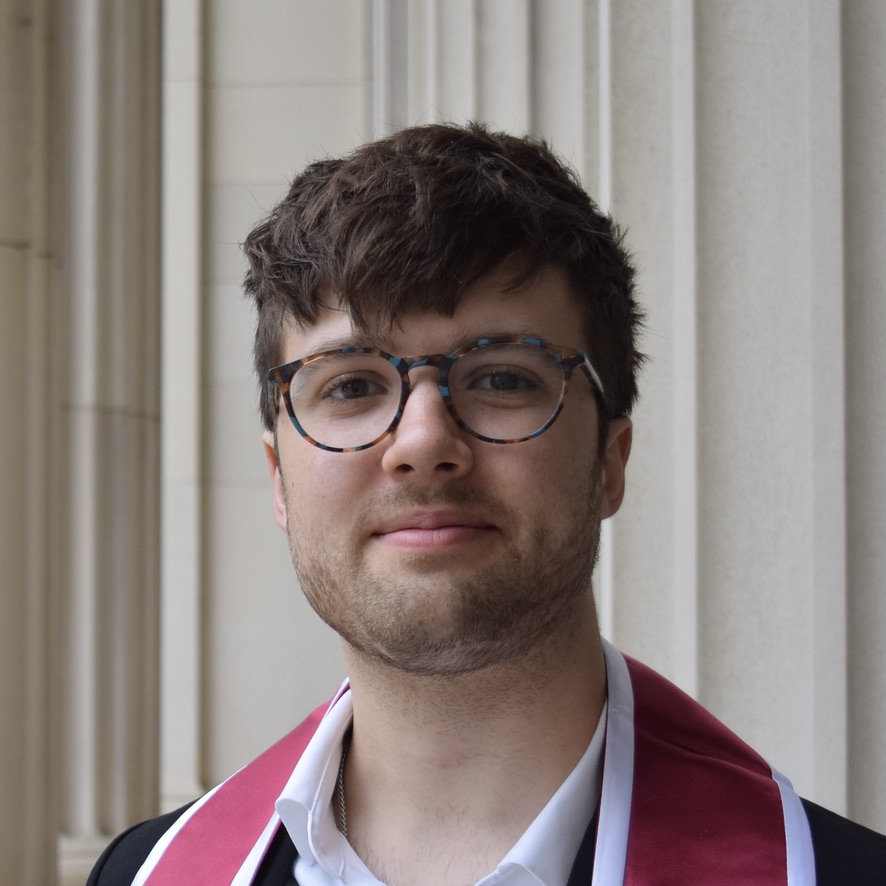
Professor Ian Moult was born in Vancouver, Canada and obtained his undergraduate degree from University of British Columbia in 2011. Professor Moult earned his PhD in theoretical particle physics in 2016 under professor Ian Stewart at MIT. He has held postdoctoral positions at UC Berkeley (Lawrence Berkeley National Laboratory) and Stanford (Stanford Linear Accelerator Center). In 2021, Professor Moult joined Yale as a professor of theoretical high energy physics (HEP). Professor Moult’s research is broadly centered on furthering our understanding of fundamental physics through developing new theoretical techniques tailored to HEP experiments, such as the large hadron collider (LHC) at CERN.
A significant portion of his work revolves around the study of particle jets in high-energy collisions. When high energy particles are smashed together in experiments such as the LHC they generate a firework-like explosion of particles spewing out in all directions. Often, these particles form streams that radiate outward from the collision center—a phenomenon known as particle jets. Professor Moult is a global leader in the physics behind these jets. Specifically, Professor Moult has made significant contributions to the topic of jet-substructure which probes the physics governing the behavior of particles within particle jets.
Outside of physics, professor Moult rides BMX.
Q&A
Questions are shown in bold with Professor Moult’s response in listed below each question. This interview has been edited for length and clarity.
You can listen to an AI dictation of this interview below generated through Speechify:
What got you into science / physics when you were younger? What put you on your current path?
At the beginning of undergrad, I was into science and math generally, but I wasn’t super into the research side of things. I’m originally from Canada, and in Canada, they have a program where a bunch of undergraduate students get to go to CERN for a summer. And so this was right when the LHC was starting up. I got to go to CERN for an entire summer and try working on some of the experiments. This was all very useful for me, because at that time, I didn’t really understand the difference between a theorist and experimentalist. There I did some work, coding things up, and realized this wasn’t quite aligned with what I had thought research physics was.
There were some great lectures there that talked about theoretical physics and seeing the whole environment of people at CERN and some of these theorists motivated me to go into particle physics. In my second year of undergrad, I got really into physics and decided that that was the direction I wanted to go. So it was a bit late, compared to many people.
Were you doing research as an undergrad?
I did research, but I was jumping around a little bit. I did some work on neutrinos and I worked in an AMO lab. I enjoyed them, but it wasn’t quite the thing that really captivated my interest. And so I bounced around in some of these different research positions until I found particle physics.
Is there anything that happened that shaped your career direction?
So even when I got to MIT, I was still a little bit flexible between theory and experiment. And so I think at MIT, the thing that really got me, particularly in the direction that I am now, was interacting with a lot of the postdocs there. So I think one of the nice things about MIT is there’s a huge number of people doing extremely good research. And so both my advisor, who was amazing, Ian Stewart, but also a lot of the postdocs there. The thing that was really nice about the postdocs is that I got to work on my own projects with them. And so having a project that was really my own.
I got involved in these projects on Jet substructure, with some of the new postdocs there and these were really my own thing. This is what got me into research where you’re thinking about it all the time and developing your own ideas. I would say it was really the influence of postdocs at MIT that got me into [this direction] and that’s still the direction I kind of, loosely speaking, work on today. So that I would say the younger postdocs at MIT brought fresh ideas as compared to the faculty, who are obviously great.
When in your education did you feel like you started to understand your subject?
I think one thing with theoretical or any area, especially now, is that it is so specialized. I think you begin to feel that you understand a very, very, very small area very well. Lance Dixon, who I did my postdoc with, has this analogy that he believes, as a postdoc or a student, you want to drill a very deep hole in one very, very specific area, and then start to broaden out and get a bigger view. Within the area of jet substructure, I was lucky because I was around the people that were really leading it and I got up to speed pretty fast. You can jump to the front in a very, very, very niche area.
I felt pretty fast that I was on top of that area, but of course, that’s very small within the bigger areas of physics. And it takes a very long time to get a view of how that fits in with the broader picture. If you look at the very high level talks that are giving an overview of the field and really connecting all the areas, this is something which is very, very hard, and you really need to have a bird’s eye view.
How would you describe your work at three different levels?
The first one is sort of like a non physics person.
The second one is a physics undergrad who has taken quantum mechanics 1.
The third is another HEP theory professor
Non-physics person level
So my work is trying to learn about the fundamental structure of what’s within nuclei or within particles. And so one way of trying to do this is to collide things at very high energy. So this is just like a car accident. If you smash things together, you get some debris which comes out. This is what is done in particle colliders, for example, at CERN, and then you try and look at the patterns of what comes out to try and reconstruct what was in there. This is split up into analysis strategies where you try and piece together these collisions and figure things out.
In physics, one has the ability to do calculations. So we try to use models to calculate in different scenarios what patterns we would see and match those to what we have. The goal of this is to try and find out new things that happened at very short time scales. So it’s a detective type problem of looking at what you have and trying to understand what could have given rise to those particular patterns.
Physics undergraduate level
So the current fundamental understanding of things we have is based on two theories. Largely for what I’m doing we’re neglecting general relativity, so it’s based on the principles of special relativity and quantum mechanics. These give us a very rigid foundation which allows us to understand the scattering of particles. Within these frameworks, we have very powerful techniques to be able to calculate, if we scatter two things, what comes out.
In particular, the specific model that we use, which is just a list of particles which interact with the principles of quantum mechanics and special relativity, is something called the standard model. And so this contains all the particles that you’re used to, like electrons, quarks, gluons and other particles which mediate different forces.
And these principles of special relativity and quantum mechanics tell us how these different particles can interact if they’re scattered off each other. My main interest is in trying to calculate how this actually happens. Although we understand it in principle, it’s very hard to actually do these calculations. Because we understand the implications of quantum mechanics and special relativity very well, we’re able to look for small deviations which might indicate the presence of new particles or new principles of nature. And so we rely on the fact that we have a very deep understanding of the principles of special relativity and quantum mechanics, which allow us to make precise predictions and look for anything beyond that.
Theoretical Physics Professor
So my main interest is in trying to connect recent developments in formal theory, often from conformal field theory or from mathematical developments in the study of scattering amplitudes, with real world physics using an effective field theory philosophy. In these very complicated collider experiments, you can’t really calculate everything. So what you try to do is to use a Wilsonian effective field theory perspective to write down specific effective field theories which allow you to describe these collisions, and then this reduces their calculation to specific universal quantities. Once this is done you can then use more sophisticated techniques from quantum field theory to really understand these objects precisely.
So one of the nice things about using these effective field theory approaches is that you often get enhanced symmetries, which really allow you to compute the underlying scattering amplitudes in a very efficient way. So I really try to bridge formal techniques with the world, primarily collider experiments, to make predictions about what you actually see in the real world.
Do you feel like your research has a driving goal?
I think there’s a variety of different driving goals, both on the theory side and on the phenomenology side. So there’s obviously very concrete goals which are trying to better understand the standard model and how it breaks down. We believe that the standard model has to be replaced by something else and one of the goals of these experiments is to probe when it will break down. On the formal side, one of my main interests is in studying these scattering observables. I hope that by deeply understanding these we can try and look for some more fundamental principles which tell you how to go beyond quantum field theory.
One analogy which is often used here is in classical mechanics. If you use the Newtonian F =MA formalism, it’s almost impossible to generalize to quantum mechanics, whereas once you start using the Lagrangian or Hamiltonian formalisms, it then becomes much easier to understand how you could generalize these things. So a lot of the hope is that by understanding things we know very deeply, you could generalize them in some way.
There’s both just clear cut phenomenological motivation, but also the thing that actually interests me more is the structure of these calculations and trying to really understand them at a deeper level.
Do you view yourself as a phenomenologist or a formal theorist? Or do you not like to put those labels?
I think at this point, I prefer not to put the label. One thing which I really like is being able to really communicate both with an experimentalist and with a pure mathematician. That’s very hard to achieve, but I think that’s the thing that interests me in physics in particular. In physics we have the ability to apply these very niche / deep mathematical ideas to real world phenomena. To me, it’s really fascinating that you can use very current mathematics to make predictions that experimentalists are looking for.
What stage do you start to think about experimental results?
I think a lot of the things that I have been most inspired by have been driven by experiment. In particular, as new experiments come on, their ability to do things that one couldn’t do before. Similarly, as new mathematics appears, you’re now able to tackle a wider variety of problems. As a theorist is interested in making connections with the real world, you need to know what the experimentalists can actually do.
Also a lot of the things that come from experiments are surprising. One of the lessons which has been repeatedly emphasized is that in theory we should always work with observable quantities, things that experimentalists can actually measure. For example, in the development of QCD you would never have guessed the end result without experiment. That was an amazing interplay between theory and experiment which brought many of these ideas like confinement or asymptotic freedom out of very confusing experimental clues.
Do you think the field of high energy physics or high energy theory is in an overall healthy state?
Are we asking the right questions?
Are theory and experiment interacting enough?
So there’s a lot in this. One of the issues with physics is you have to operate within some financial system and there’s many questions about funding. Putting those aside, I actually think it is in a very exciting or healthy era. One obvious thing is that I came in right after turning on the LHC and this cleaned the slate on a lot of those old incorrect models.
Now, people are going back to really thinking about quantum field theory. I think right now there is a better connection between fundamental quantum field theory and high energy and that’s developing in a number of very exciting directions. Personally I am very excited by the interaction between a lot of new ideas coming in from formal theory and their interaction with real phenomenology.
So when people see a lot of stuff in the media about high energy physics not being healthy, I think a lot of these come from a little bit of a misconception about what it should be about. If it’s really just like finding some new particle every couple of weeks, then that didn’t play out, but in terms of the research that is being prioritized now, I actually think it’s going in a very healthy direction. Both from the mathematical side and from the machine learning side you have a huge amount of really powerful new techniques coming in. I personally am actually extremely excited with the direction that things are going.
Terence Tao talks about mathematicians as birds or frogs. Frogs are in the mud and they’re very focused in one area. Almost like the experts on one really deep niche topic. Then the birds fly around all different problems, and they use many different topics to solve problems. So I was curious, if you identify with either of these sorts of analogies?
Physics has become so separated that I would like to say that I am a bird in one subfield, but overall, maybe a frog. And I think that’s what physics has gone to. The part that interests me within my area is trying to connect these different topics and in that sense I like the bird side of things to a certain level. Especially for theorists, I think one can get too high up as a bird and completely just disengage. So I like the bird aspect, but with a very specific goal in mind.
In Thomas Kuhn’s book, The Structure of Scientific Revolutions he introduced this idea of paradigm shifts. He describes science evolving through periods of normalcy followed by rapid progress called paradigm shifts. Is there anything that you think of that, if we figured it out, would trigger a new paradigm shift?
Even things like grand unification are not enough because they’re still really working within the framework of local quantum field theory. A lot of the open questions are related to these naturalness problems, or these hierarchy problems, like the electroweak hierarchy problem or the cosmological constant. And I think it’s really the resolution of these that will have to require some fundamental paradigm shift that isn’t just adding new particles.
Okay, we’re getting to time. I ask this question to a lot of academics across many topics, just because I think it’s an interesting question. What is the most recent thing you learned that got you excited?
Yeah, so in my field, something that I’ve got quite excited about recently is some of these new techniques for calculating scattering amplitude called the amplituhedron. I’ve now become convinced that this is actually some practical way of computing some of these jet substructure observables that I’m interested in. So I’ve been having a lot of fun learning some of the mathematical literature behind this.
The reason I was actually interested in it for these jets is if you want to describe many, many particles in the jet, eventually it becomes very complicated. With this new method they were able to get, like, one gluon splitting into 12 gluons. That has like 22 million terms or something, but you can just get it out immediately from this object.